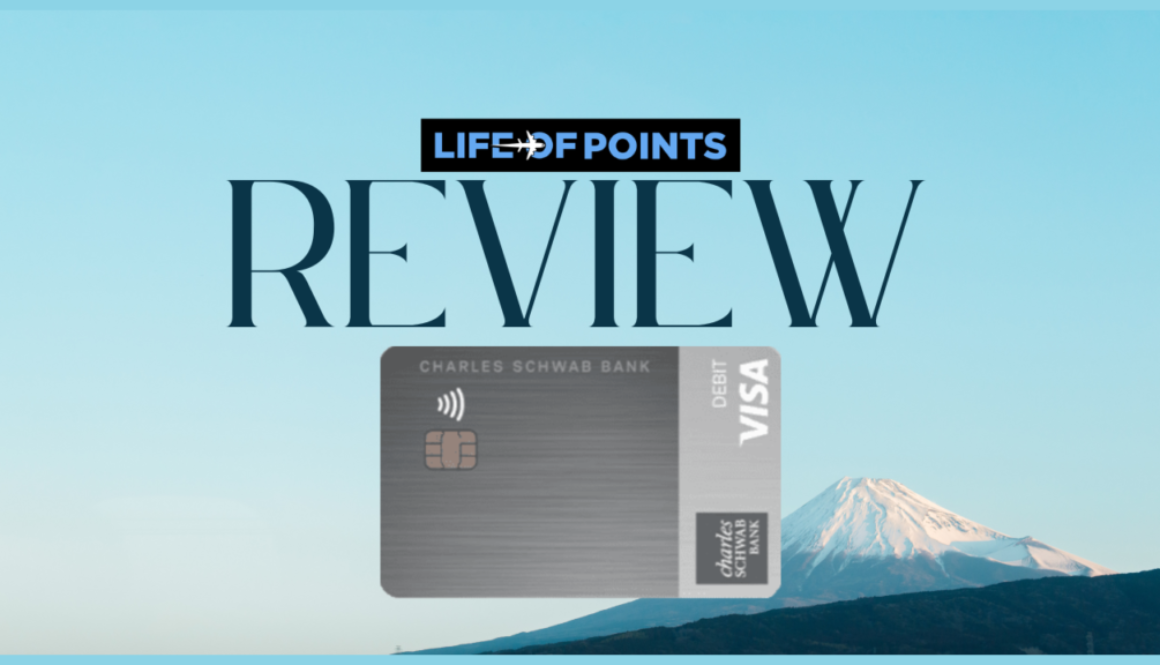
For travelers, managing money abroad can be a major source of stress. Enter the Charles Schwab Investor Checking Debit card – a financial tool that has become a favorite here at Life of Points and among international travelers. This card offers many travel-friendly benefits over traditional checking accounts, with its ‘superpower’ being its advantages for withdrawing money abroad.
Unlimited ATM Fee Rebates Worldwide
Our favorite feature of the Charles Schwab debit card is its unlimited ATM fee rebates worldwide. Yes, you read that right. This means you can use any ATM, anywhere in the world, without worrying about fees. At the end of each month, your account is reimbursed by Schwab for all ATM fees incurred, putting the money back into your account.
This feature eliminates the need to carry large amounts of cash or waste time searching for specific ATMs to avoid fees. Instead, you can use the most convenient ATM available, knowing that any fees will be refunded.
Screenshot of ATM fee rebate
No Foreign Transaction Fees
Another advantage for international travelers is the absence of foreign transaction fees. While we at Life of Points generally advise against using debit cards for purchases abroad, this card’s elimination of foreign transaction fees makes it a viable option if you need to use it.
Many banks charge a percentage (typically 1-3%) on every transaction made in a foreign currency. These fees can quickly add up, especially on longer trips.
No Minimum Balance Requirements
Unlike other checking accounts, the Schwab Investor Checking account has no minimum balance requirements or monthly fees.
The absence of minimum balance requirements and monthly fees makes this account ideal for use as a dedicated travel account. Before any international trip I normally load the account up with my expected expenses (plus a little extra spending money).
Tip: Fund the account about 10 days before your trip as transfers to this account take longer than usual.
Additional Travel-Friendly Features
Beyond its main benefit for withdrawing money abroad, the Schwab debit card offers other travel-friendly features. These include travel accident and travel insurance, purchase protection, and extended warranty coverage on eligible purchases.
The Bottom Line
Whether you’re a digital nomad, a frequent business traveler, or an occasional vacationer, the Charles Schwab Investor Checking Debit card offers a great set of travel-friendly features. Its combination of unlimited ATM fee rebates, no foreign transaction fees, and no minimum balance make it an excellent tool for managing money while traveling.
Join our Discord server to connect with travelers, get the latest tips, and have your questions answered!
Get a glimpse into Japan’s Edo Era with the Nakasendo Way. The Nakasendo is a 700 year old path connecting the former capital of Japan, Kyoto, and the current, Tokyo.
The totality of the route is over 300 miles, but you can break it down into a 1-3 day trip to capture the highlights and magic of the route.
Described by a local as the most picturesque spot on the Nakasendo Way
THE NAKASENDO EXPERIENCE
On the Nakasendo, you’ll spend half your day walking through the valleys of the beautiful Japanese mountains, and the other half exploring well preserved towns that dot the path.
This makes the Nakasendo more of a walk than a hike. Unlike the Shimanami Kaido (internal link) or Kumano Kodo, no physical training is required.
Adventurous eaters will be interested to hear that there are restaurants along the route that serve horse sashimi.
An idyllic pathway along the Nakasendo Way with a post town in the distance
AUTHENTIC ACCOMMODATIONS
The accommodations along the Nakasendo Way are a large part of its appeal. Options consist of Minshuku (Japanese guest house) and Ryokan (upscale, traditional Japanese inn).
When traveling across the world to experience a new culture, you do yourself a disservice by staying in western style accommodations. Do yourself a favor and experience a Minshuku, Ryokan, or at least a business hotel.
MINSHUKU KOSHINZUKA
We stayed in Minshuku Koshinzuka, just outside of Tsumago. Our host was both charming and accommodating. During dinner, he sang songs and told us about the history of his family and the area. This turned what would have been just a futon to sleep on, into a genuine highlight of the trip.
I would not trade my night at Minshuku Koshinzuka for a night at the nicest 5 star hotel in Japan.
Communal area at Minshuku Koshinzuka
HOW THE NAKASENDO FITS INTO YOUR JAPAN TRIP
The typical Japan vacation itinerary is 2 weeks spread across Tokyo, Osaka, and Kyoto. If you’re interested in mixing things up, I recommend skipping Kyoto and replacing it with the Nakasendo Way or Shimanami Kaido (internal link).
In my opinion, the food is better in Osaka, and the atmosphere is better in Tokyo. Shrines, culture and history are abundant in Japan, so trading Kyoto for a unique adventure is something you won’t regret.
LOGISTICS AND FEASIBILITY
One of the reasons the typical Japan itinerary is so popular is because it’s simple to book and easy to manage. So, how does the Nakasendo compare?
In short, it’s more work, but not as much as you’d think.
BOOKING ACCOMMODATIONS
Lodging is limited, but booking far out (6 months or more is best) solves this issue
Some accommodations require you to book via email instead of online. The language barrier can make this harder than it needs to be
TRANSPORTATION
Despite not having a large city nearby, there are plenty of public transport options to get to/from the Nakasendo
Google Maps makes navigating public transport in Japan a breeze
NAVIGATING THE PATH
The path is well marked, so finding your way is easy. Detours are also well marked and most signs have English on them
LUGGAGE CONSIDERATIONS
Luggage forwarding services operate like clockwork in Japan, and are available along the most popular part of the Nakasendo way (the Magome and Tsumago sections)
BEWARE BEARS
Encounters are rare, but there are bears in this part of Japan. The local government does a good job of putting up notices if there is a recent sighting. There are many “bear bells” along the way which you are encouraged to ring loudly to help keep them out of the area.
FINAL THOUGHTS
The Nakasendo way is a great way to break the mold of the typical Japan itinerary. It’s easy to get to and provides an experience you won’t find in the big cities.
If you like the idea of mixing up your Japan trip, check out our article on the Shimanami Kaido for a more adventurous option.
Here at Life of Points we are all about redeeming our points and miles. Therefore, we’ve found the best tools for travelers to maximize their rewards and streamline the booking process. One of the biggest challenges in the points and miles world is the time-consuming task of searching across all the various airline websites for deals and itineraries that work for you.
That is where our preferred points search engine steps in. Seats.aero is a powerful web-based tool that allows users to search for flights, track availability, and set alerts for when a new redemption option becomes available.
Whether you’re a seasoned points traveler or just starting your journey into the world of points and miles, this guide will teach you how to use Seats.aero to its fullest potential.
Explore
Seats.aero’s Explore function can be accessed from the home page and allows users to search for flights with their preferred airline mileage program. Each airline program’s transfer partners are also conveniently displayed so you won’t have to memorize or spend time searching for these details.
If you’re using the free-version of the tool you’ll be limited to flights within the next 60 days, and you will not have access to the filters on the page. Free-users will only be able to use the search function, or sort by clicking the column headers.
Paid “PRO” users can refine their search by specifying departure and arrival airports, number of seats needed, maximum points for redemption, preferred days of the week, and direct flights only. Additionally, PRO users have access to results up to a year in advance.
In the image above you will see two flights leaving out of Montréal-Trudeau International Airport (YUL). Results and their corresponding point cost can be found on the right in a simple color-coded system. Blue indicates the route includes layovers, and green indicates the flight is direct.
For more information, you can click on the gray info button on the right of the page. This will prompt you with the popup seen below. In the resulting popup, important information such as flight time, point cost, taxes, and operating carrier can be found.
A nice feature of Seats.aero is that it displays results of airlines’ alliance partners. In the example below we searched the United MileagePlus program and got a result operated by Air Canada. This flight being operated by Air Canada is bookable using your United MileagePlus points. Clicking the blue Book via United MileagePlus button will initiate the booking process on United’s website.
Search
Users frequently rely on the Search function to plan trips since it offers precise filters tailored to individual needs. This tool provides the flexibility to search across multiple airports and includes filters for loyalty programs, alliances, transfer partners, and more.
One of the more handy features of the Search function is the integration of Multi-Airport codes. These allow users to use one code to search a broader area or an airline’s major hubs. You can view these codes by clicking the grey Multi-Airport Codes button at the top of the screen. A snippet of the codes can be seen below.
Example using Search function
Let’s begin with a hypothetical trip itinerary. For this search, we’ll assume we want to depart from the Miami area for a European vacation. Let’s also assume that we have a stash of American Express and Chase points.
We begin the search by entering QMI as our origin airport, which represents the Miami Metropolitan Area airports (MIA, FLL, and PBI). We use EUR as our destination airport which represents all large European airports.
After clicking search, the filters will appear. Because we have American Express and Chase points I will narrow our search to include flights only bookable with these two point currencies.
The narrowed-down results are shown below.
We see that the results show a mix of direct and non-direct flights and range from 12,500 points in economy-class up to 107,700 points in first-class. As we learned earlier, clicking the info button on the right-side of each result will display important details about each flight.
In this example, Miami to London (MIA-LHR) with Virgin Atlantic costs 12,500 points and $152.80. The $152.80 consists of a government imposed charge and an airline imposed surcharge. Always be aware of what the taxes are on award flights as they can occasionally be prohibitively expensive.
Create Alerts
The last of the main Seats.aero functions is the ability to create alerts. If your search doesn’t yield any results or the available options don’t align with your travel plans, you can set up an alert to be notified when new options become available. Creating alerts is a powerful feature that ensures you don’t miss out on new redemption opportunities that fit your travel plans.
Below is a screenshot of an example alert for our sample trip:
Note that SMS notifications and ability to choose a range of days are restricted to PRO users.
Conclusion
Seats.aero is an invaluable tool for travelers looking to maximize their points and miles. Whether you are searching for flights, or setting alerts for new redemption opportunities, Seats.aero simplifies the process and saves you time.
With features tailored to both free and PRO users, it offers flexibility and precision in planning your trips. By mastering Seats.aero, you can make the most out of your rewards and enjoy seamless travel experiences!
If you’re unsure how to maximize your points and miles or need advice on planning your trip, join our Discord server and ask away!
Affiliate Disclosure: This post contains affiliate links. If you purchase through these links, Life of Points LLC may earn a commission at no additional cost to you. Your support helps keep this site running!
All right, so you’ve made the decision to ditch that old roller bag of yours and make traveling simpler by switching to carry-on backpacking. No more paying checked bag fees, waiting at baggage claim, or hauling 40-pound bags over the cobblestone streets of Europe. Now, you can breeze through airports, hop on and off public transport, and even explore nearby hiking trails!
But what bag should you choose? Well, having traveled across the U.S., Caribbean, Europe, and Asia in recent years, I have discovered the best carry-on backpack setup available today.
The Osprey Farpoint 40 is a perennial favorite among adventure, budget, and minimalist travelers. However, before you dismiss this as just another Farpoint review, let me explain how the Farpoint transforms into the ultimate travel bag when paired with Osprey’s Daylite pack.
ORGANIZATION AND FEATURES
Farpoint 40:
One of my favorite features of the Farpoint 40 is the large main compartment that opens up like a suitcase. Since the bag opens up suitcase-style, the stresses of digging through your bag to find an item is gone.
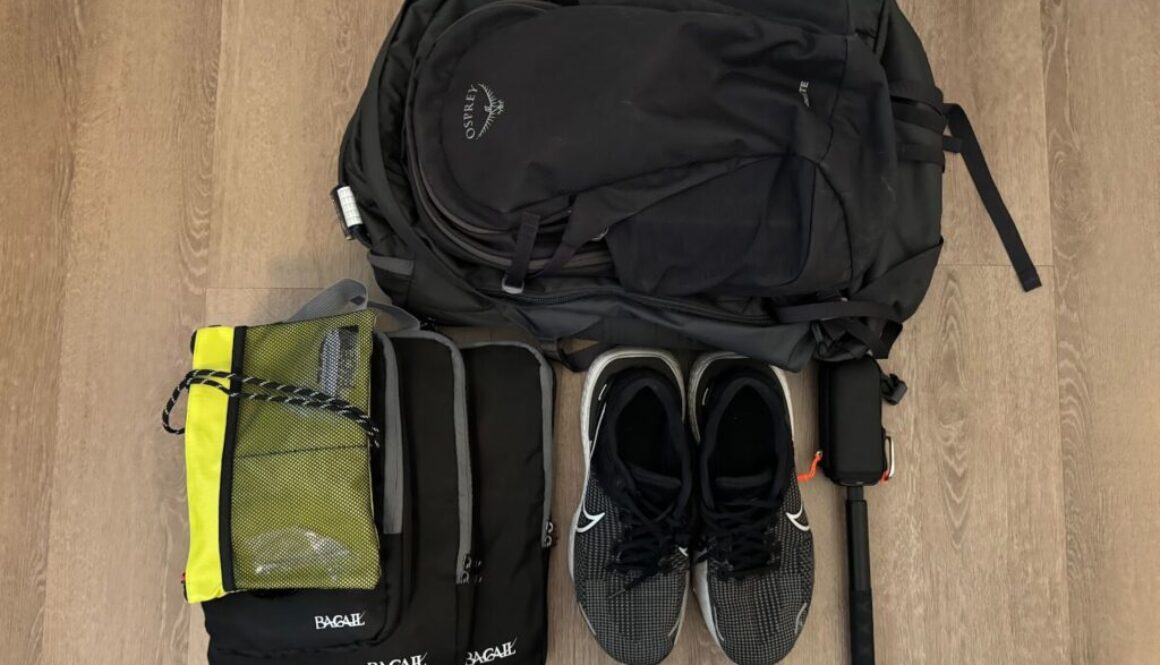
Now, some say that this bag lacks some essential organization, but this is easily fixed with the use of packing cubes. Using packing cubes in the main compartment of the bag allows for seemingly unlimited configuration.
Once your items are packed in the main compartment, the bag offers compression straps to cinch down your items offering a few extra liters.
Inside the main ‘flap’ of the bag, a large mesh zipper pocket is there to hold smaller items.
Outside the main compartment, the bag features a front stow pocket. This pocket is helpful for things you might need quick access to like a packable rain jacket. This is my least used pocket because I use the Farpoint 40 in tandem with the Daylite pack.
Next, we have a small pocket on the top of the bag which is useful for small items like a sunglasses case, phone, or keys (key clip included inside).
Lastly, this bag includes a large laptop compartment big enough to stow any laptop you may have.
Daylite:
When I am in transit with this bag attached to the Farpoint I like to keep it fairly empty to avoid creating unnecessary bulk. If needed, the Daylite has one main compartment that you can store things that just didn’t fit into the Farpoint. I normally store my water bottle in the main compartment of the Daylite because the Farpoint does not include any side water bottle pockets.
DAYLITE: THE PERFECT COMPANION
What sets this bag setup apart from other options is the detachable Daylite day pack. Throughout my travels, this bag has been the perfect companion once I arrive at my destination and can leave my larger Farpoint at my accommodation.
The Daylite is perfect to have when exploring your destination. It has two valuable side pockets for water bottles, enough space in the main compartment for a camera, a small umbrella, and any tchotchkes you may purchase throughout your day.
HIKING:
A feature I have come to really enjoy about the Daylite pack is the inclusion of a water bladder pocket. With this, I have a capable day hiking pack that is large enough to carry a full sized water bladder, food, some hiking gear, and two more water bottles in the exterior side pockets.
Although this two bag solution is my favorite backpack setup right now, it isn’t perfect. There are two changes I am hoping to see in future iterations. First I’d like to see side bottle pockets added to the Farpoint 40. Everyone travels with a bottle so why make us store it inside the bag?
Next, I’d like to see Osprey’s AirSpeed back system included. Once you have used an Osprey bag with the AirSpeed system it is hard to go back to anything else.
The added ventilation helps you stay cool on longer walks and warmer days. Osprey offers a special edition of the Farpoint 55 called the ‘Farpoint 55 Trek,’ which includes the AirSpeed system. Whether they introduce it to the Farpoint 40 or develop a Farpoint 40 Trek Edition, it will be a welcome addition.
CONCLUSION
The combination of Osprey’s Farpoint 40 and Daylite pack creates a carry-on travel system that is versatile, efficient, and ready to handle any kind of travel. With the large customizable interior and added convenience of a separate day pack, this setup is perfect for any traveler looking to simplify their journeys.